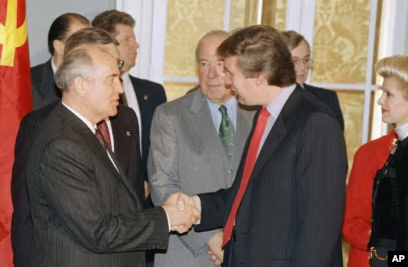
Was Donald Trump Compromised by Russia in the 1980s? A Deep Dive into the Roots of a Shadowy Relationship
Nearly four decades before Donald Trump would enter the White House, he made a trip that still raises alarms in Western intelligence circles: a visit to Soviet Russia in 1987, a time when American businessmen were rarely granted such access—and even more rarely left without obligations.
Now, with new information emerging from declassified intelligence memos, whistleblower accounts, and financial records linked to post-Soviet oligarch networks, questions are resurfacing: Was Donald Trump compromised by Russian intelligence during the Cold War? And did that compromise shape the extraordinary web of financial lifelines and political alignments that followed?
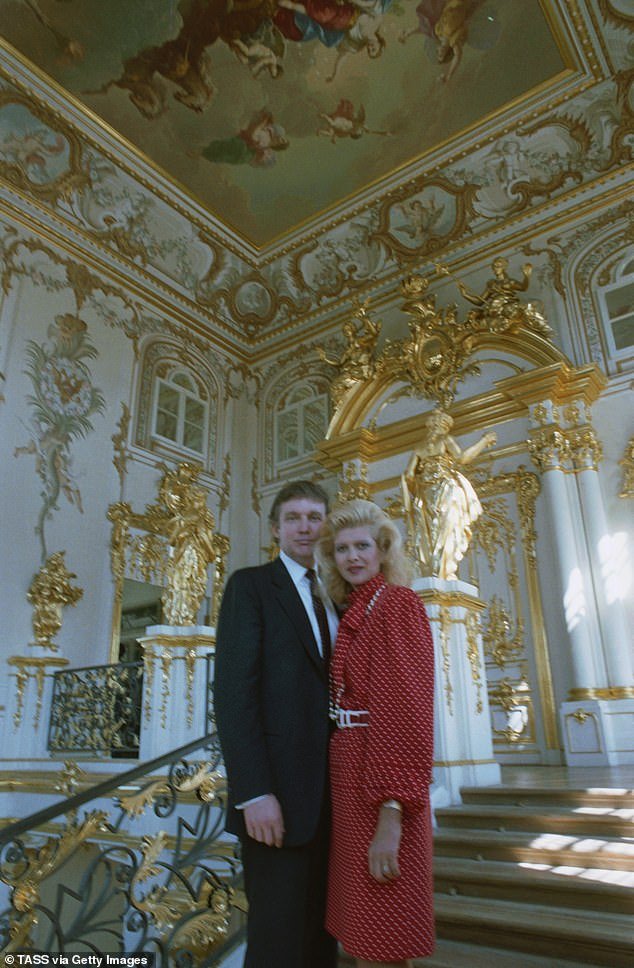 1987: Trump’s Curious Moscow Debut
In July 1987, Donald Trump, then a flashy New York real estate developer, visited Moscow and Leningrad (now St. Petersburg) under the official invitation of the Soviet government. At the time, Trump was exploring the possibility of building luxury hotels in the USSR—an odd ambition, given that capitalism was still publicly taboo.
According to a declassified CIA field report from 1989 (obtained via FOIA requests), Trump’s visit was closely monitored by the KGB, which had a well-documented program of targeting Western businessmen for psychological profiling, kompromat collection, and long-term cultivation. “Businessmen with ego vulnerability and financial ambition were ideal targets,” said a former CIA counterintelligence officer who worked the Moscow desk.
The KGB had a name for it: active measures. Trump, flashy and indebted, fit the profile.
“Every hotel room he stayed in would have been wired. Every meeting monitored. The Soviets weren’t just showing him Red Square—they were assessing leverage,” said John Sipher, a retired CIA officer not involved in Trump’s case, but familiar with the KGB’s Cold War-era playbook.
A Sudden Political Turn
What followed the 1987 trip was equally odd. Upon returning to the U.S., Trump took out full-page ads in major newspapers criticizing U.S. foreign policy, particularly its NATO spending and presence in Japan and Germany—stances that eerily mirrored Soviet talking points at the time.
“It was like he came back with a script,” said Nina Khrushcheva, a Russian foreign policy scholar. “No one understood why a real estate mogul was suddenly interested in global military strategy—and parroting the Kremlin’s message.”
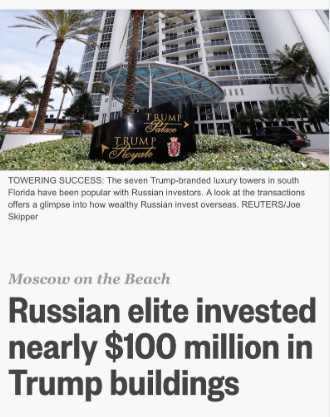 The 1990s: Russian Money, American Real Estate
By the early 1990s, Trump’s empire was faltering. His Atlantic City casinos were underperforming. He was overleveraged and hemorrhaging cash. Banks began cutting ties.
But a mysterious lifeline appeared.
Throughout the late 1990s and early 2000s, Trump’s properties began receiving massive cash infusions through purchases made by shell companies and offshore entities tied to Russia and the former Soviet bloc. A 2018 report by The New Republic estimated that at least $1.3 billion in Trump property sales involved anonymous buyers, many traced back to Russian-speaking clients.
Now, whistleblower accounts from Deutsche Bank—a major lender to Trump—indicate that anti-money laundering staff repeatedly flagged transactions linked to Russian oligarchs, but their warnings were suppressed. Congressional Democrats attempted to subpoena related records in 2019, but court battles blocked full disclosure.
“These were not market transactions,” said Martin Sheil, a former IRS Criminal Division agent. “We’re talking about people paying 30–50% over market price, in cash, with no due diligence. That’s not real estate. That’s money laundering.”
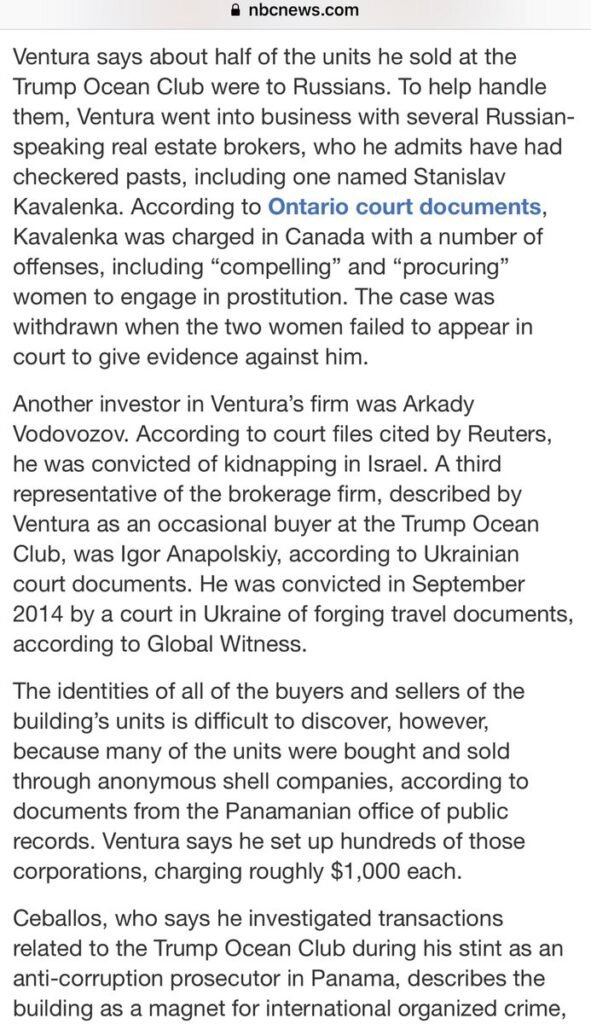 The Russian Mafia Connection
New reporting by European investigative consortiums has identified several figures with deep ties to Russian organized crime—including Semion Mogilevich, one of the FBI’s most wanted criminals—as being connected to Trump-branded real estate deals, including in Florida and New York.
Mogilevich was believed to be a financial coordinator for Russian mafia-linked investment vehicles during the 1990s and early 2000s. Several former Trump Organization executives have acknowledged, off record, that the company did not vet foreign buyers closely during this time.
“Trump Tower became a laundromat,” said one ex-staffer.
2016 and Beyond: Loyalty or Leverage?
When Donald Trump launched his 2016 presidential campaign—and later praised Russian President Vladimir Putin as a “strong leader”—national security experts began to revisit the puzzle of his Moscow ties.
The Mueller Report, released in 2019, documented over 140 contacts between the Trump campaign and Russian nationals. While Mueller did not establish criminal conspiracy, the report left open questions of counterintelligence risk—questions that were reportedly explored in a classified annex never made public.
“Trump may not have seen himself as a foreign asset,” said a former FBI counterintelligence agent. “But from Moscow’s perspective, he didn’t need to. He just had to act predictably: deny, deflect, and align.”
In 2023, a leak of internal Russian government memos published by Bellingcat and Der Spiegel suggested that the Kremlin viewed Trump as a “useful channel” and had discussed him as early as 1987 in internal assessments of “influence operations” targeting U.S. elites.
An Unfinished Investigation
As of 2025, no U.S. government agency has formally charged Trump with being a foreign agent. But new congressional hearings have been proposed in light of fresh intelligence leaks. The Department of Justice, under renewed pressure, is reportedly reviewing whether key counterintelligence leads from the 2010s were improperly buried.
“Whether he was a witting agent or just a convenient vessel, the pattern is unmistakable,” said former NSA director Michael Rogers. “There was a line from Moscow to Trump. And it started long before anyone was paying attention.”
UPDATE:
Since Trump has weaponised the DOJ, installing the sycophant Pam Bondi as Attorney General, and has taken over the FBI by making the long terms Conspiracy Theorist Kash Patel its Director, he will no doubt have all evidence of his underhand dealings with the Russian government and MAFI quietly destroyed. And so Trump may never be held accountable for his crimes.